“This analysis explores data from a reliability engineering study designed to select the optimal power source for industrial sensors used in harsh environments (e.g., downhole drilling or autoclaves). The experiment investigates the Service Life (in hours) of the batteries based on two factors:
Here is the modified and formatted text, ready for your R Markdown file:
The objective is to characterize the reliability of these power sources across the full thermal range. A critical specific aim is to investigate the presence of an interaction effect: to determine if the ‘High-Temp’ chemistry successfully maintains its voltage stability at 125°C, a point where standard consumer-grade batteries are expected to suffer catastrophic capacity loss.
8.2 Data Setup and Preparation
First, we organize the raw data into a structured data.frame. This is a best practice in R that makes the data easier to manage and the code more readable. We create columns for the response variable life and the two factors, material and temperature, ensuring they are treated as categorical variables (factors) for the analysis.
Code
## Response variable: battery lifelife <-c(130,155,74,180, 34,40,80,75, 20,70,82,58,150,188,159,126, 136,122,106,115, 25,70,58,45,138,110,168,160, 174,120,150,139, 96,104,82,60)## Create the data framebattery_df <-data.frame(life = life,material =factor(rep(1:3, each =12)),temperature =factor(rep(rep(c(15, 70, 125), each =4), 3)))## Preview the databattery_df
8.3 Exploratory Data Analysis and Visualization
Before fitting a formal model, we visualize the data to get an intuition for the relationships between the factors and the response.
8.4 Boxplots of Main Effects
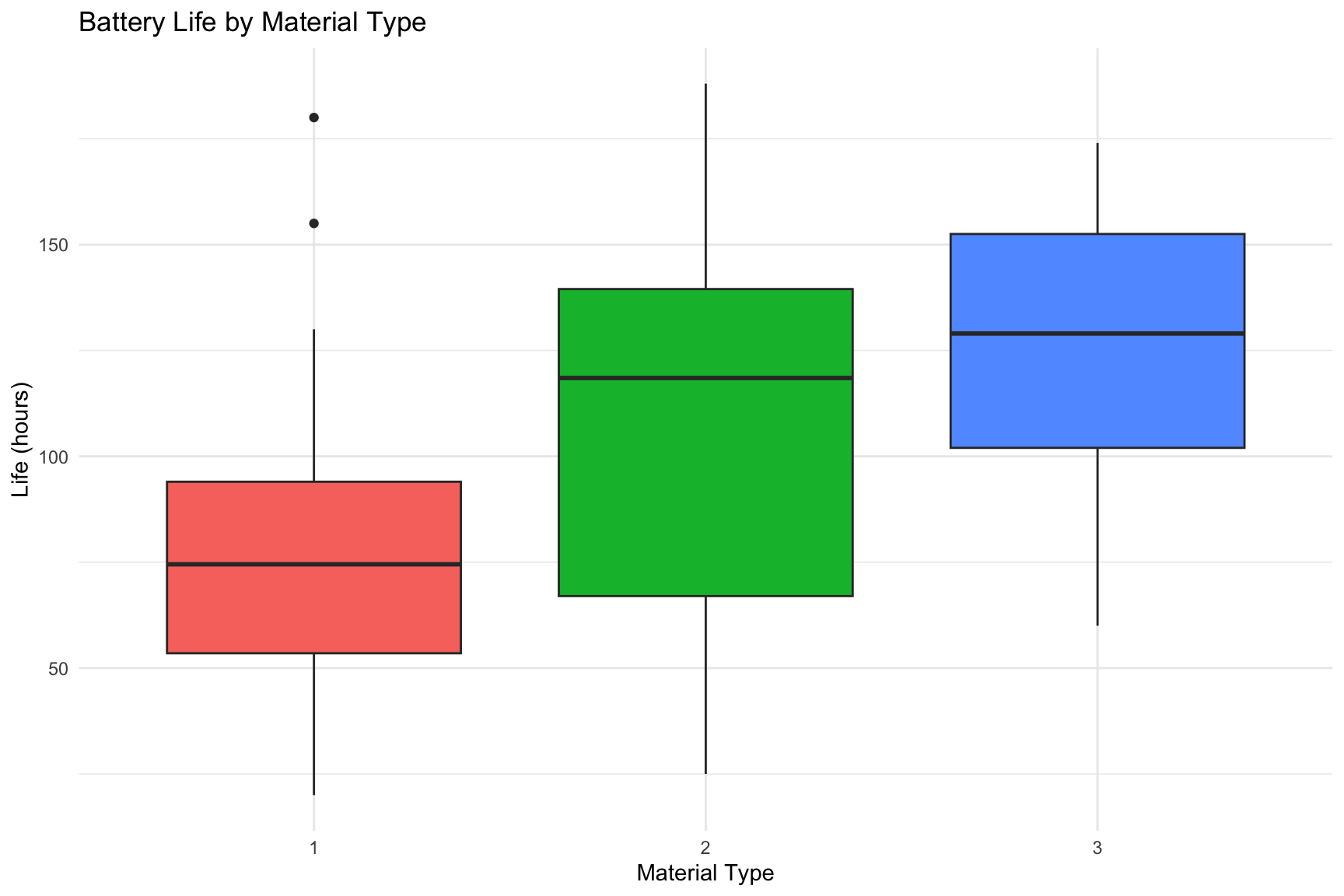
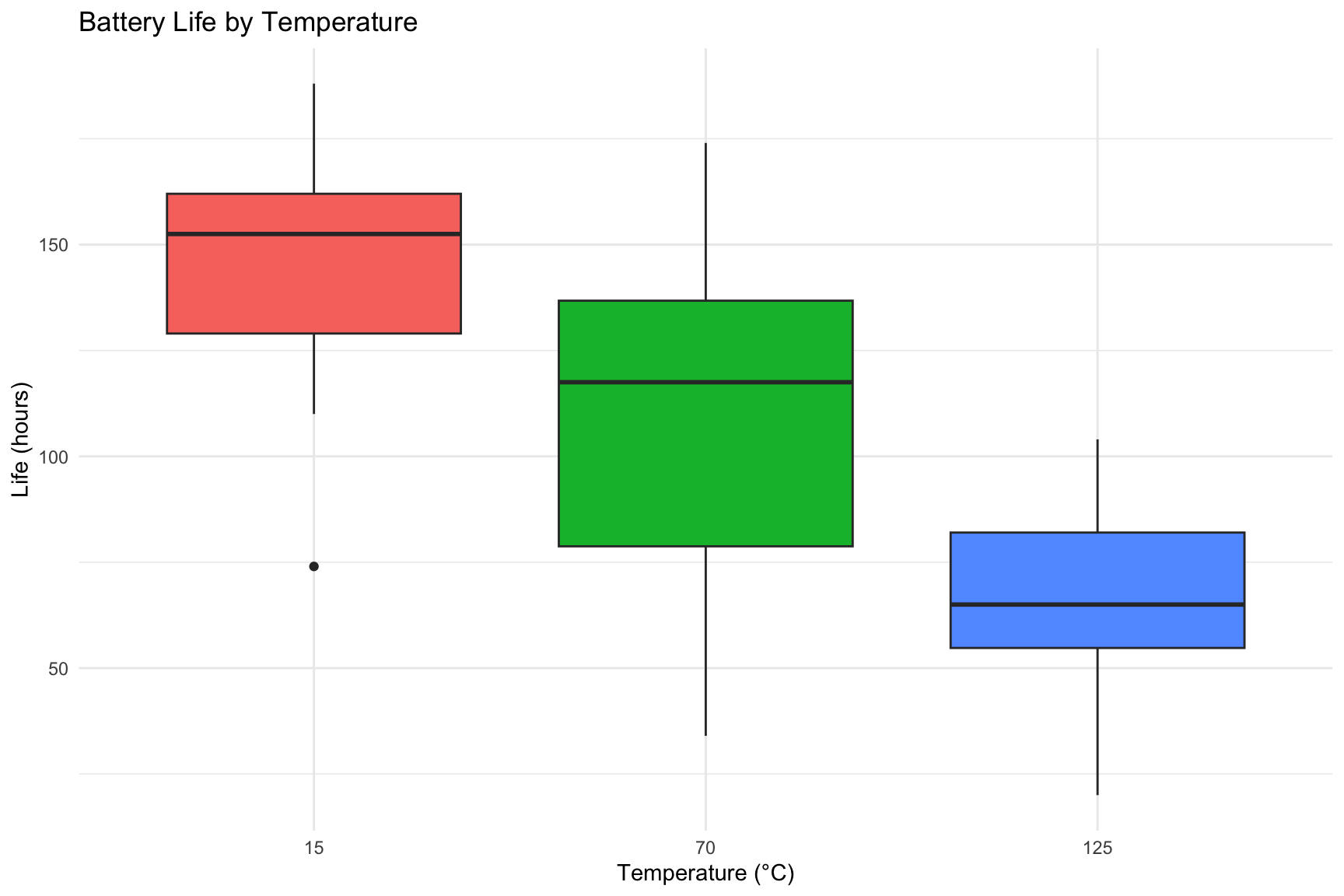
Boxplots are excellent for examining the distribution of battery life for each level of our factors independently. This gives us a preliminary look at the main effects—the individual impact of material type and temperature.
Code
library(ggplot2)## Boxplot for Material Typeggplot(battery_df, aes(x = material, y = life, fill = material)) +geom_boxplot() +labs(title ="Battery Life by Material Type", x ="Material Type", y ="Life (hours)") +theme_minimal() +theme(legend.position ="none")## Boxplot for Temperatureggplot(battery_df, aes(x = temperature, y = life, fill = temperature)) +geom_boxplot() +labs(title ="Battery Life by Temperature", x ="Temperature (°C)", y ="Life (hours)") +theme_minimal() +theme(legend.position ="none")
Distribution of Battery Life by Material and Temperature.
Distribution of Battery Life by Material and Temperature.
8.5 Interaction Plot
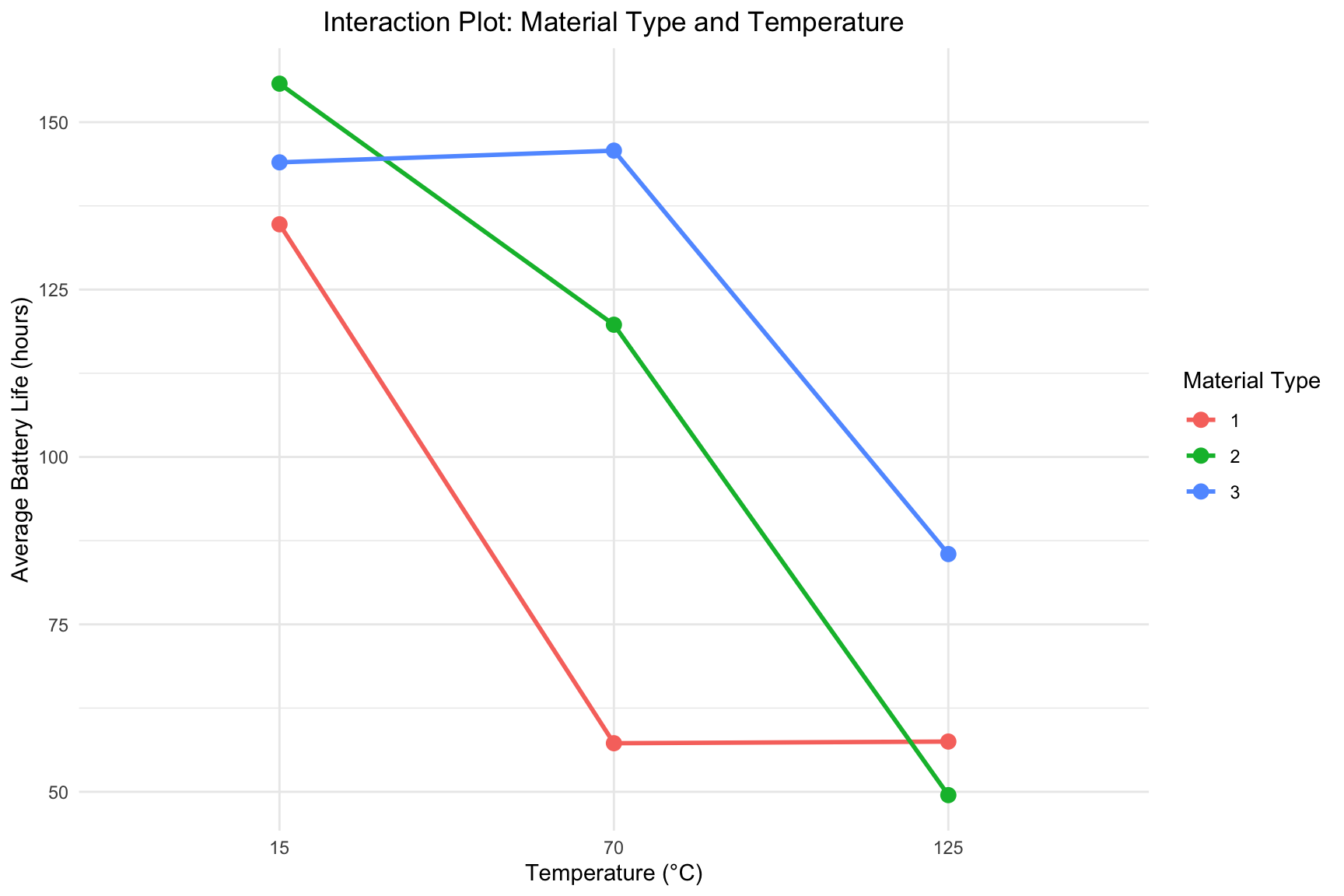
The most crucial plot for a factorial experiment is the interaction plot. It displays the mean battery life for each combination of material and temperature. If the lines are parallel, it suggests there is no interaction. If the lines are not parallel (i.e., they cross or diverge), it indicates that the effect of temperature on battery life is different for each material type, signaling a likely interaction.
Code
ggplot(battery_df, aes(x = temperature, y = life, group = material, color = material)) +stat_summary(fun = mean, geom ="line", size =1) +stat_summary(fun = mean, geom ="point", size =3) +labs(title ="Interaction Plot: Material Type and Temperature",x ="Temperature (°C)",y ="Average Battery Life (hours)",color ="Material Type" ) +theme_minimal() +theme(plot.title =element_text(hjust =0.5))
Interaction between Material Type and Temperature.
The interaction plot reveals a strong interaction effect between Material Type and Temperature, meaning the performance profile is distinct for each chemistry:
Material 1 (Standard Li-ion):
This material is suitable only for cool environments. While it provides adequate life at \(15^\circ\text{C}\) (~135 hours), it suffers a catastrophic drop in performance at \(70^\circ\text{C}\) and stays consistently poor at \(125^\circ\text{C}\) (~55 hours). It is not viable for high-temperature operations.
Material 2 (Industrial Li-MnO\(_2\)):
This is the superior choice for cold starts, offering the highest lifespan of all materials at \(15^\circ\text{C}\) (~155 hours). However, it degrades linearly and severely as temperature rises, ultimately becoming the worst performer at extreme heat (\(125^\circ\text{C}\)), dropping to ~50 hours.
Material 3 (High-Temp Li-SOCl\(_2\)):
This material demonstrates exceptional thermal stability. Unlike the others, its performance actually peaks at the operating temperature of \(70^\circ\text{C}\). Crucially, it is the only viable option for extreme heat (\(125^\circ\text{C}\)), maintaining a usable lifespan of ~85 hours when others have failed.
Summary: There is no single “best” material overall. The optimal choice depends entirely on the environment: Material 2 for cold applications and Material 3 for any environment exceeding room temperature.
8.6 Model Fitting and Analysis of Variance (ANOVA)
We now fit a linear model to formally test the significance of the main effects and the interaction term. The model life ~ material * temperature is shorthand for life ~ material + temperature + material:temperature. We use a sum-to-zero contrast (contr.sum) for balanced interpretation of the effects. The ANOVA table will tell us if the variation caused by our factors is statistically significant compared to the random variation in the data.
Code
## Fit the full factorial modelbattery_fit <-lm(life ~ material * temperature, data = battery_df,contrasts =list(material = contr.sum, temperature = contr.sum))summary(battery_fit)
Call:
lm(formula = life ~ material * temperature, data = battery_df,
    contrasts = list(material = contr.sum, temperature = contr.sum))

Residuals:
    Min      1Q  Median      3Q     Max
-60.750 -14.625   1.375  17.938  45.250

Coefficients:
                       Estimate Std. Error t value Pr(>|t|)
(Intercept)             105.528      4.331  24.367  < 2e-16 ***
material1               -22.361      6.125  -3.651  0.00111 **
material2                 2.806      6.125   0.458  0.65057
temperature1             39.306      6.125   6.418  7.1e-07 ***
temperature2              2.056      6.125   0.336  0.73975
material1:temperature1   12.278      8.662   1.417  0.16778
material2:temperature1    8.111      8.662   0.936  0.35735
material1:temperature2  -27.972      8.662  -3.229  0.00325 **
material2:temperature2    9.361      8.662   1.081  0.28936
---
Signif. codes:  0 '***' 0.001 '**' 0.01 '*' 0.05 '.' 0.1 ' ' 1

Residual standard error: 25.98 on 27 degrees of freedom
Multiple R-squared:  0.7652,    Adjusted R-squared:  0.6956
F-statistic:    11 on 8 and 27 DF,  p-value: 9.426e-07
ANOVA Results
Code
## Generate the ANOVA tableknitr::kable(anova(battery_fit), digits=3)
Df
Sum Sq
Mean Sq
F value
Pr(>F)
material
2
10683.722
5341.861
7.911
0.002
temperature
2
39118.722
19559.361
28.968
0.000
material:temperature
4
9613.778
2403.444
3.560
0.019
Residuals
27
18230.750
675.213
NA
NA
The ANOVA table shows very small p-values (Pr(>F)) for material, temperature, and, most importantly, the material:temperature interaction. This confirms our visual inspection: all effects are statistically significant. Because the interaction is significant, our interpretation should focus on the interaction itself rather than the main effects in isolation.
8.7 Model Adequacy Checks
The validity of our ANOVA results depends on the model’s residuals meeting certain assumptions (normality, constant variance, independence). We check these with diagnostic plots.
Code
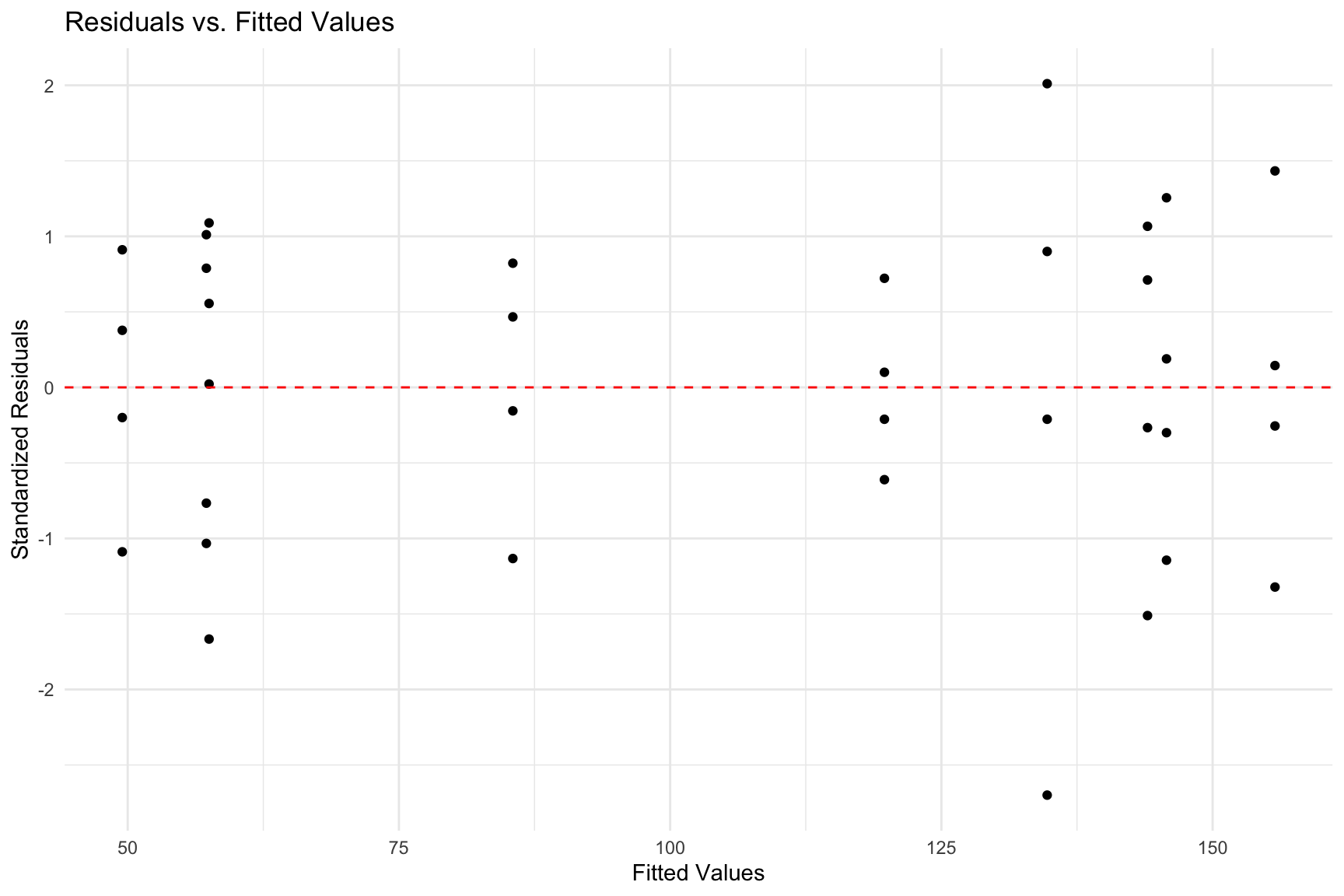
## Extract standardized residuals and fitted valuesbattery_fit_diag <-data.frame(residuals =rstandard(battery_fit),fitted =fitted.values(battery_fit))## Normal Q-Q Plotp1 <-ggplot(battery_fit_diag, aes(sample = residuals)) +stat_qq() +stat_qq_line() +labs(title ="Normal Q-Q Plot", x ="Theoretical Quantiles", y ="Standardized Residuals") +theme_minimal()## Residuals vs. Fitted Plotp2 <-ggplot(battery_fit_diag, aes(x = fitted, y = residuals)) +geom_point() +geom_hline(yintercept =0, linetype ="dashed", color ="red") +labs(title ="Residuals vs. Fitted Values", x ="Fitted Values", y ="Standardized Residuals") +theme_minimal()p1 p2
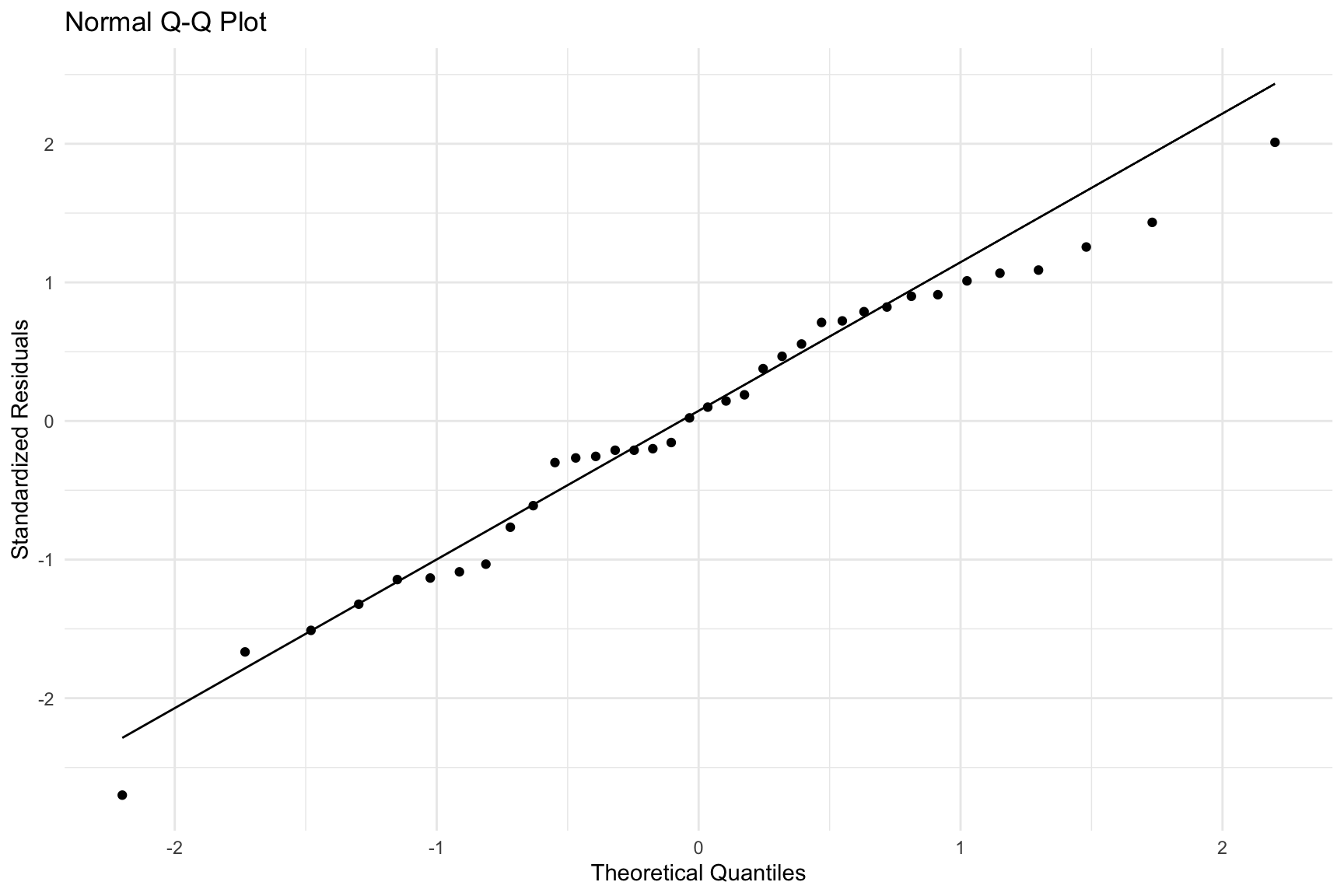
Diagnostic plots for the battery life model.
Diagnostic plots for the battery life model.
The Normal Q-Q plot shows the points falling roughly along the line, suggesting the normality assumption is met. The Residuals vs. Fitted plot shows a random scatter of points around the zero line, indicating that the variance is reasonably constant. The model assumptions appear to be satisfied.
8.8 Post-Hoc Analysis: Pairwise Comparisons
Since the interaction is significant, we must compare the means of the nine specific treatment combinations (3 materials × 3 temperatures). Simply comparing the average effect of Material 1 vs. Material 2 would be misleading, as that difference depends on the temperature.
8.9 Tukey’s HSD Test
Tukey’s Honest Significant Difference (HSD) test is a post-hoc test that compares all possible pairs of means while controlling the family-wise error rate. We apply it to an aov model object. The output for the material:temperature interaction shows which specific combinations are significantly different from one another.
Code
## Fit the model using aov() for Tukey's testbattery_aov <-aov(life ~ material * temperature, data = battery_df)## Perform Tukey's HSD testTukeyHSD(battery_aov)
The Fisher’s Least Significant Difference (LSD) method is another option for pairwise comparisons. To test the interaction means, we must specify both factors in the trt argument.
Code
library(agricolae)## Perform LSD test on the interaction termlsd_results <-LSD.test(battery_aov, trt =c("material", "temperature"),p.adj ="none", group =FALSE)## Print the comparison tableprint(lsd_results$comparison)
The results from both Tukey’s HSD and Fisher’s LSD provide detailed p-values for comparing pairs of treatment combinations, allowing us to make specific conclusions, such as “at 125°C, Material 3 has a significantly longer life than Materials 1 and 2.”
8.11 Analysis of Entropy
ANOEN Table
Code
library(ANOEN)print(anoen(battery_fit), format ="gt")
ANOEN Table of Linear Model for Battery Data
Analysis of Entropy (ANOEN)
Model Family: gaussian
Term
Model Complexity
Entropy Info
Entropy-based \(R^2\)
Significance
\(p\)
\(\Delta p\)
\(\text{df}_c\)
\(d_{\text{adj}}\)
\(\hat I_H\)
Partial
Comp.
Cum.
\(\chi^2\)
\(F_{Seq}\)
material
3.0000
2.0000
2.1183
10.4533
0.0892
0.0853
0.0853
0.0853
0.0775
0.0869
temperature
5.0000
2.0000
2.2507
9.6383
0.8150
0.5574
0.5098
0.5951
0.0000
0.0000
material:temperature
9.0000
4.0000
4.9734
9.3529
0.2854
0.2483
0.1005
0.6956
0.0092
0.0186
Model
9.0000
8.0000
9.3424
9.3529
1.1896
0.6956
0.6956
0.6956
0.0000
0.0000
ANOEN Pie Chart
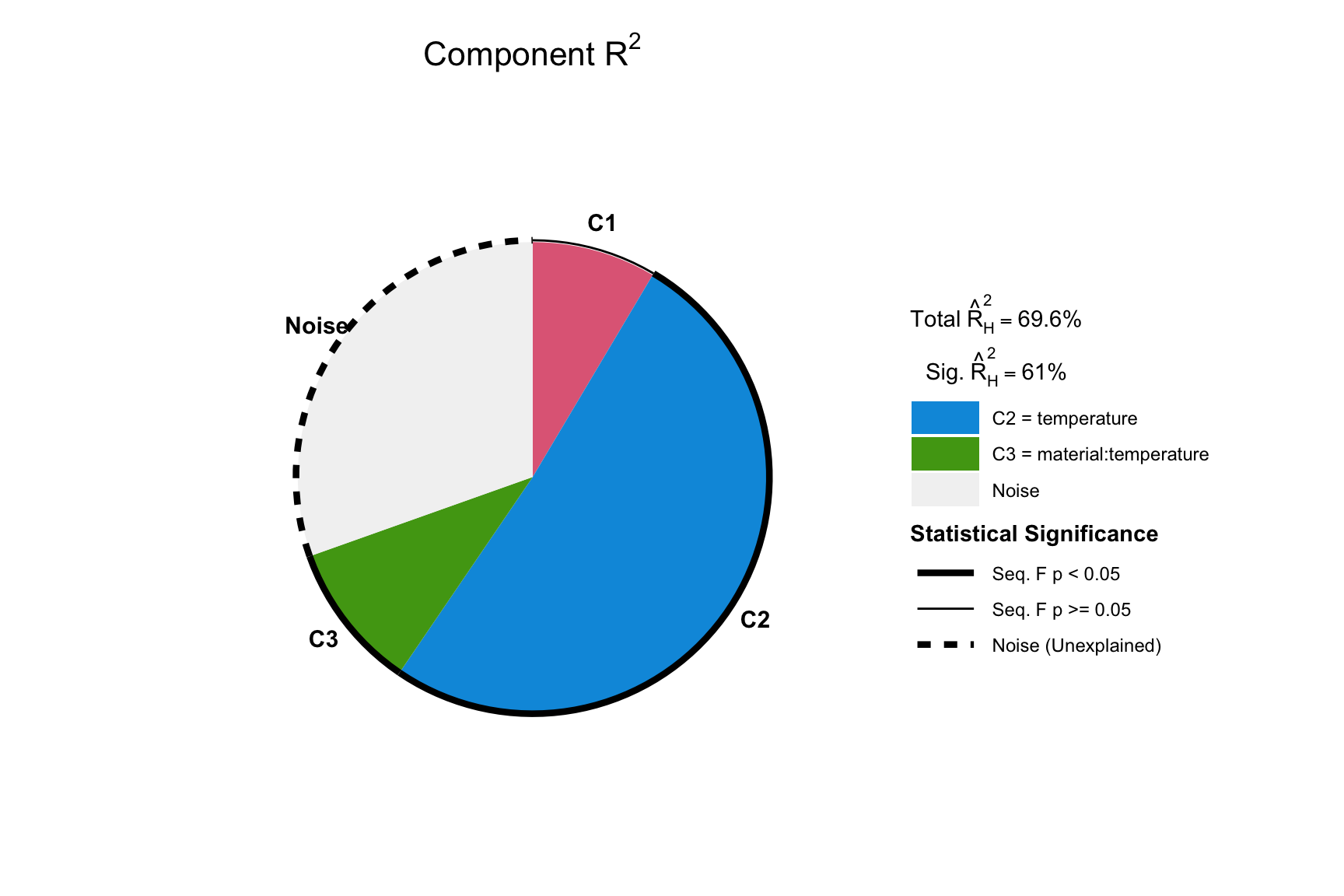
Figure 8.1 shows the component \(R^2_\text{adj}\). This pie chart shows us the percentage of contributions of each term in the total variance of battery life.
Code
graph.compR2(anoen(battery_fit))
Figure 8.1: Component \(R^2_\text{adj}\) of Linear Model for Battery Data